Who’s funding system change in Oxfordshire?
The urgent call for deep, long term investment in neighbourhood transformation
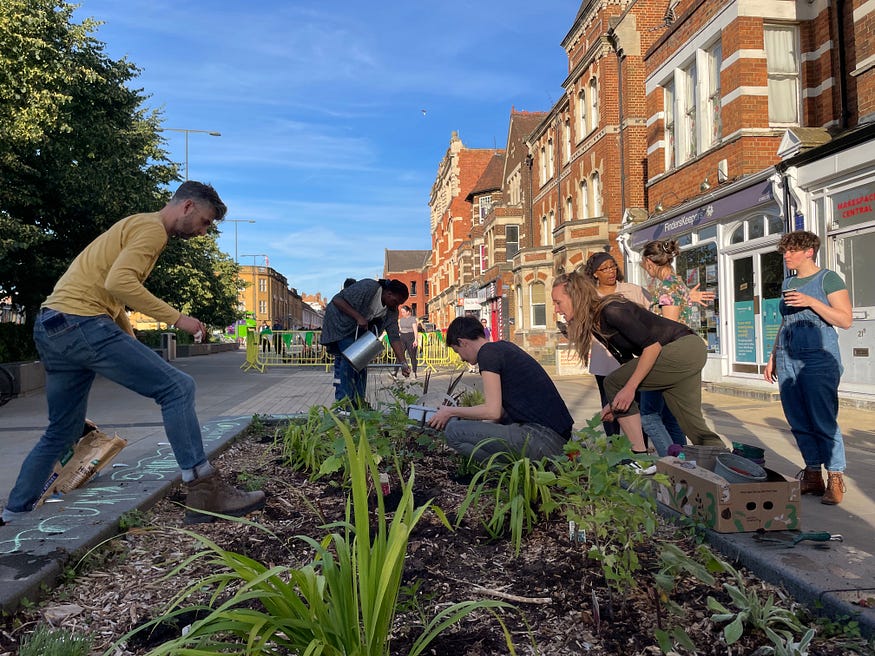
In one of the wealthiest counties in England, too many people are still being left behind. Scratch beneath the surface of Oxfordshire’s prosperity and a different story soon emerges. So, what can we do to tackle the eye-watering inequality in Oxfordshire, and who is resourcing the work?
The government’s newly published Indices of Deprivation statistics show some positive signs, with fewer wards in the bottom 10% and 20% of deprivation, but with wealth at the top increasing, inequality remains stark and is widening.
The Director of Public Health Oxfordshire has highlighted this is a major issue for our county. Research shows that children on free school meals have worse outcomes in affluent areas. These outcomes, in part, stem from unequal access to the spaces, resources and security that enable people to thrive. In Oxfordshire, who gets to learn, work, gather and belong is still shaped by a system that concentrates opportunity rather than sharing it.
The statistics point to something deeper than inequity. They reveal a system working exactly as it was designed. It aims to extract, not to redistribute; to accumulate, not to care.
Local communities have the will and imagination needed to transform their neighbourhoods. What’s missing is the funding to enable change at a deep, systemic level. There simply isn’t the long-term resourcing needed to redesign how wealth, land, and power flow through our places. A vast gap exists between the scale of the challenge and the money available to meet it.
We draw hope and inspiration from those grappling with this question across the UK. We’re buoyed by Onion Collective’s Hope for Alternative Futures series, Civic Square’s Endowing the Future, Dark Matter Labs’ experiments in rewiring governance, and Amahra Spence’s call to “re-code the engine room” of philanthropy and community infrastructure, among others.
So who, in Oxfordshire, is funding the work of system change? And what exactly does that mean?
What do we mean by system change?
At Makespace Oxfordshire, we talk about system change as the paradigm shift from private property and profit as ends in themselves, toward a vision of spatial justice. Where everyone has access to the spaces they need to live happy, creative, and connected lives. Where long term community stewardship takes the place of ownership.
The crises we face — inequality, climate breakdown, isolation, deepening polarisation, unhealthy and unaffordable housing — are symptoms of the same root problems. They’re not isolated issues but intersecting failures of a system shaped by patriarchy, colonialism, and capitalism. Under its logic, anything that questions the primacy of profit is cast as “radical” or “unrealistic,” even as the status quo continues to unravel our communities and ecosystems.
In the words of Onion Collective,
“From the increasingly large number of places and peoples which are hurt by rampant capitalism, conceiving a post-capitalist future doesn’t look radical or extreme and also isn’t a difficult act of imagination; it’s a necessary fact of survival in the face of ongoing suffering and planetary destruction.”
System change looks beneath the visible problems to the “dark matter” that underpins them — the stories, structures, and incentives that quietly dictate how space, money, and power move. It asks us to fund not only projects but ideas, relationships, and knowledge.
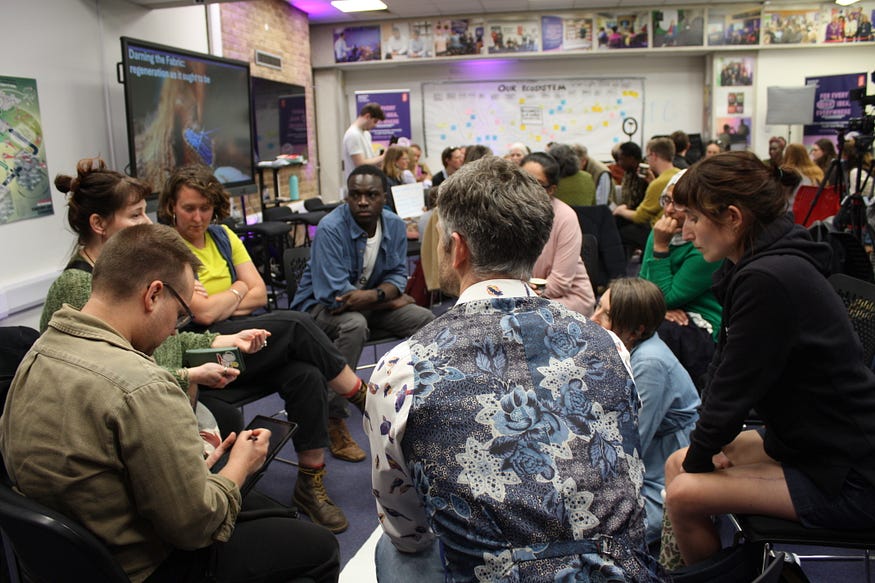
It means rewiring our land and property system to be more democratically owned, halting the sell-off of public land and building a system that incentivises regenerative and reparative uses, not speculation and profit extraction. Examples include retrofitting existing homes and streets , resourcing more social and community led carbon positive homes and neighbourhoods, local food growing, and a more circular economy with access to spaces for sharing and repairing goods.
It’s about transforming the underlying operating system of our places from one built on ownership, scarcity, and competition, to one grounded in commons, care, and relational regeneration.
Current failures in funding
Changing an entire system isn’t neat work that can be wrapped up in one funding cycle and summarised in a single impact report. And the current system of funding isn’t yet rising to the challenge. Some funders are experimenting with different models, but it isn’t going far enough yet.
According to Bex Trevalyan, co-founder of Platform Places, “£84 billion is locked up in the endowments of the 300 largest charitable foundations in the UK.” She notes there’s an urgent need for this to “shift and flow out into communities — to build local wealth and power to organise in the face of crises.”
Philanthropy too often functions as both benefactor and gatekeeper. Foundations sustain the very work that critiques them, but they frequently do so on with short cycles, tightly specified deliverables, and reporting frameworks that shape projects to fit funder appetites rather than community need. Amahra Spence calls this the nonprofit industrial complex (drawing on the seminal work of INCITE!, who coined the term) and names philanthropy as the “power supply” that also constrains how change can be imagined and delivered.
The numbers also expose the gap between rhetoric and resourcing. Onion Collective’s research shows how small the funding slice is that actually supports “alternative futures” and the organisational work that holds them. The pieces focused on system change represent only a tiny fraction (about 1.2%) of UK philanthropic and charitable funding. That’s a startling mismatch between the scale of the challenge and the money flowing to it.
The combined effect of these failures is to fund outputs rather than infrastructure. Short grant cycles reward visible deliverables while under-resourcing the “engine room” of administration, technology, governance and care that Amahra Spence and others argue is essential to maintaining movement capacity over the long run. Many community groups are left chronically under-resourced for the patient, messy work of system change.
Scale of the challenge and opportunity
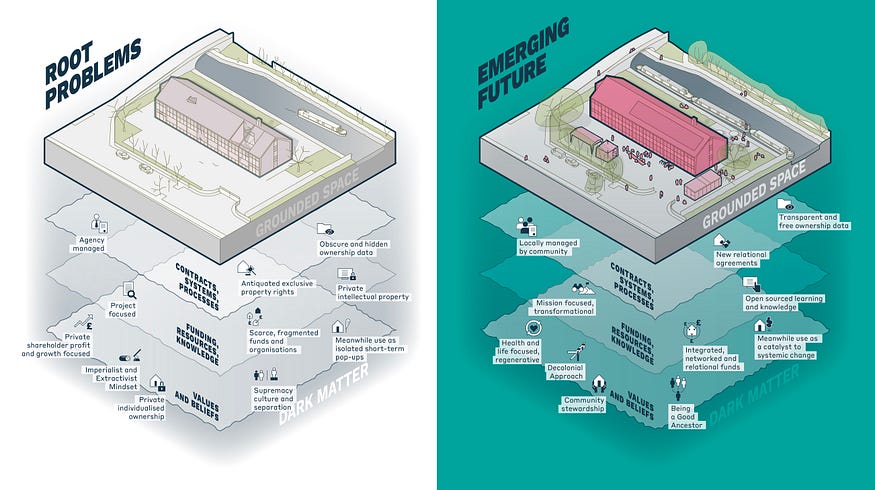
The scale of what needs to change can feel overwhelming. As we wrote in our Path Towards Spatial Justice piece, we’re living through a “polycrisis.” Overlapping emergencies in housing, climate, care and democracy are each feeding the other. The same extractive logic that drives climate breakdown is what hollows out our high streets and prices people out of their own communities.
But this complexity also brings clarity. When the systems around us fray, we can start to glimpse the possibility of building something different. The work of organisations like Onion Collective and Civic Square shows that hope is not naïve optimism, but a disciplined practice of prototyping, resourcing and maintaining alternatives.
Across the country, we see experiments in regenerative economics, civic endowments and community stewardship that prove system change is not an abstract idea but a practical craft. The challenge is immense, but so is the opportunity to reimagine how we can do things differently. To create neighborhoods, towns, and cities that are healthy, thriving, just spaces for all for generations to come.
What’s needed in Oxfordshire specifically?
If Oxfordshire is to tackle its deep inequalities, we need to invest not only in projects but in the social infrastructure that lets communities thrive. That means creating an ecosystem of spaces, organisations and relationships that nurture care, creativity and collaboration, the foundations of a more equitable local economy.
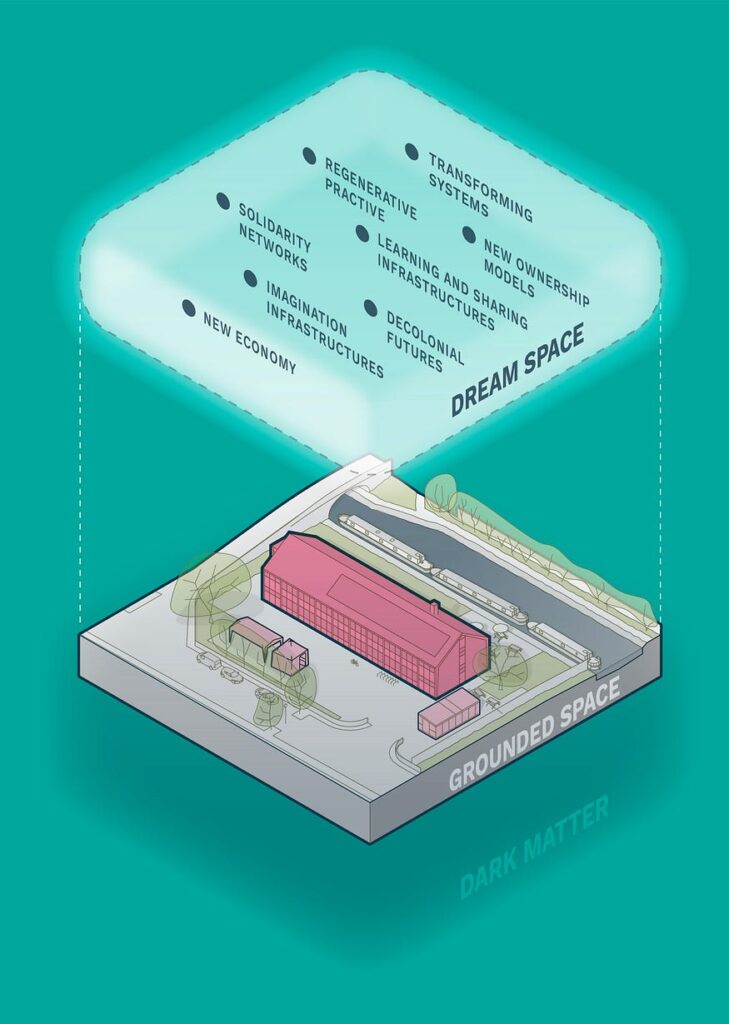
At Makespace Oxfordshire, we’ve seen how access to affordable, community-rooted buildings can transform what’s possible. Our “hub and spoke” model connects local initiatives across towns and neighbourhoods, bringing together spaces for making, repairing, growing, learning, and belonging. But these spaces only work when they’re part of a wider fabric: when they link the “new economy” — one that’s caring, sharing, ecological — with the cultural and civic life of a place.
What’s needed now is joined-up investment in this ecosystem. In the sites, skills and relationships that hold it together. We need to treat community spaces as essential public infrastructure. They shouldn’t be optional extras, but the connective tissue of a fair and regenerative Oxfordshire.
Where to begin
System change starts with resourcing the essentials. The conditions that allow people and places to flourish beyond the logic of trickle-down economics, extraction and a relentless focus on economic growth above all else.
That means first investing in the basics. Access to affordable, healthy, climate-safe housing is vitally important. Alongside this, there must be reparative land projects that reconnect people, food and economy in a symbiotic relationship with the natural world, restoring both ecology and community.
Equally vital are places to meet and make together. We need neighbourhood hubs that are collectively owned, democratically run and open to experiment. These are the spaces where imagination and action meet, where creative practice becomes social infrastructure, and where care and collaboration are woven into everyday life.
Makespace’s own model is one small example, but it must be part of something much bigger; a regional and national effort to seed the next economy. You can see this in the Mycelial Network — a group of community asset developers we’re a part of — but also in numerous organisations, collectives and community groups nationwide doing the work. Funding these experiments now will lay the groundwork for long-term, regenerative systems of housing, land, work and culture. These would be the shared foundations of a future that genuinely works for everyone.
Makespace is in it for the system change
At Makespace Oxfordshire, our mission is bigger than buildings. We’re here to help seed new systems that decide who accesses space, who has power, and who benefits from the wealth our places create. We’ve learned that real change takes time, trust, and place-rooted infrastructure. That’s the work we’re committed to, together with partners and communities across the county.
But system change needs resourcing. To answer the question this post poses, the fact is, very few people are funding system change in Oxfordshire — or elsewhere. It needs funders and investors ready to think long-term, to move beyond short project cycles and help build the patient, relational infrastructure of a fairer Oxfordshire.
If you’re part of a foundation, public body or private investor who wants to back the deep, systemic work our times demand, we’d love to talk. Because the question isn’t just who is funding system change in Oxfordshire, it’s who is ready to help make it real.
Also published on Medium